

NCAA Votes Women's Flag Football as Emerging Sport: What This Means for Young Athletes
NCAA approves women's flag football as emerging sport. Learn about scholarships, college programs, and how young athletes can pursue
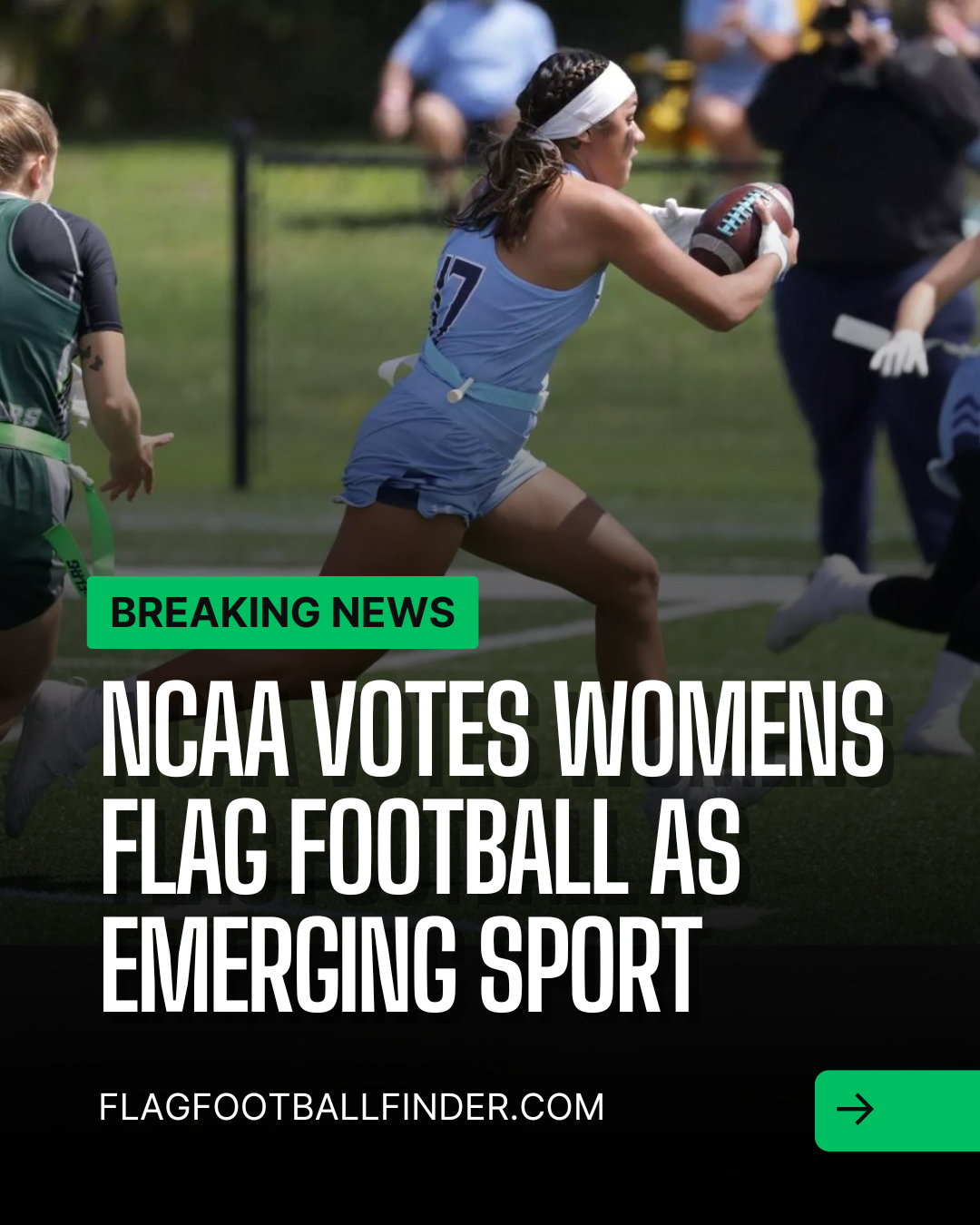


In a landmark decision at the 2026 NCAA Convention in Washington, D.C., representatives from all three NCAA divisions unanimously approved women's flag football as an NCAA Emerging Sport for Women, effective immediately. This historic vote opens the door for thousands of young female athletes to pursue college scholarships and compete at the varsity level in one of America's fastest-growing sports.
What Does "Emerging Sport" Status Mean?
The NCAA Emerging Sports for Women program provides a pathway for new sports to eventually become full championship sports. To achieve championship status, flag football must:
- Be sponsored at the varsity level by at least 40 NCAA schools
- Meet minimum contest requirements (12 games per season)
- Meet minimum participation requirements
The timeline is faster than you might think. With at least 40 schools already sponsoring women's flag football at the varsity level in the 2025-26 academic year—and projections of 60 schools competing in spring 2026—flag football could reach championship status within the next 2-3 years.
This means current middle school and high school athletes could be competing for NCAA national championships before they graduate college.
Historic Momentum: HBCUs Lead the Way
The Central Intercollegiate Athletic Association (CIAA), led by Commissioner Jacqie McWilliams, pioneered this movement by hosting a preliminary flag football season in spring 2025, with Winston-Salem State taking the inaugural championship. The CIAA will officially sponsor women's flag football as a varsity sport beginning in the 2026-27 academic year, becoming the first HBCU conference to fully sanction the sport.
"Welcoming women's flag football into the Emerging Sports for Women is a meaningful step toward expanding access, equity and opportunity," said McWilliams, who also chairs the NCAA Committee on Access, Opportunity and Impact. "This sport has already sparked passion nationwide, and now countless young women will see a path that once didn't exist."
Nebraska Makes Power Conference History
Hours after the NCAA vote, the University of Nebraska announced it would become the first Power Four conference school to add women's flag football as a varsity sport. The Huskers will begin competition in spring 2028 with:
- 15 scholarships available in year one (increasing to 20 in year two, 25 in year three)
- Season running January through May
- Head coach search beginning immediately
- Roster of approximately 15 players recruited by fall 2026
Nebraska hasn't added a sport since beach volleyball in 2013, making this decision even more significant. The addition helps Nebraska achieve Title IX proportionality while capitalizing on flag football's explosive growth nationwide.
The Scholarship Landscape: Real Money, Real Opportunities
For youth athletes and their families, the most important question is: What scholarship opportunities exist right now?
Current College Programs (2025-26):
NAIA (Pioneer since 2021)
- 17+ schools offering varsity programs
- Average roster size: 20 players
- Up to 12 full scholarships per team (typically distributed as partial scholarships)
- Schools include: Ottawa University (KS), Midland University (NE), Florida Memorial, St. Thomas (FL)
NJCAA (Rapidly Expanding)
- $10,000-$150,000 grants funding program launches
- Schools include: Hocking College (OH), College of DuPage (IL), Howard CC (MD), Jackson State CC (TN)
- Scholarships often include tuition waivers, books, fees, and stipends
NCAA Division I
- Schools launching by 2027: UT Arlington, Alabama State, Mount St. Mary's, LIU, Mercyhurst, Cal Poly
- Nebraska leading Power Four expansion (2028 start)
- Classified as equivalency sport (partial scholarships typical)
NCAA Division II
- Conference Carolinas launching spring 2026: Ferrum, Chowan, King, Lees-McRae, Mount Olive, Emmanuel
- Athletic equivalency scholarships (~$15K total per roster, divided among team)
NCAA Division III
- Empire 8 added flag football in 2025-26: SUNY Brockport, Elmira, Hartwick, Geneseo, Russell Sage
- No athletic scholarships, but academic merit and need-based aid available
Current projections: By 2028, over 100 colleges could offer varsity flag football programs with approximately 2,000 scholarship opportunities for female athletes.
What This Means for Youth Athletes
If you're a young athlete playing flag football right now, here's what you need to know:
For Current High School Athletes (Class of 2026-2028):
You are on the ground floor of a historic opportunity. With 60+ schools competing in spring 2026 and rapid expansion expected, you have a realistic path to a college scholarship that didn't exist just two years ago.
What you should do now:
- Create an athlete profile to showcase your skills and experience
- Film your games and create highlight reels
- Research schools launching programs in the next 1-3 years
- Reach out to coaches early—many are building rosters from scratch
- Attend showcase events and national tournaments where college coaches scout
Create your free athlete profile on Flag Football Finder
For Middle School Athletes (Class of 2029-2031):
You will likely have the opportunity to compete for NCAA national championships. By the time you're college-ready, women's flag football could be a full championship sport with:
- 100+ NCAA schools competing
- Conference championships across all divisions
- National championship tournaments
- Established recruiting pipelines and showcase events
What you should do now:
- Join competitive travel teams and attend elite camps
- Start building your athlete profile and game film library
- Follow college programs and understand program styles
- Develop relationships with coaches early in the process
For Elementary Athletes (Class of 2032+):
The sky's the limit. You'll grow up in an era where women's flag football has:
- Established college pathways
- Professional league opportunities (NFL-backed)
- Olympic competition (2028 LA debut)
- High school varsity programs in most states
The 2028 Olympics Factor
Flag football will debut as an Olympic sport at the 2028 Summer Olympics in Los Angeles, creating unprecedented visibility and legitimacy for the sport. This Olympic inclusion is accelerating growth at every level:
- Youth participation up 55% between 2022-2023
- 1.6 million players nationwide
- 38 states now offer high school flag football
- 20 million players worldwide
The Olympic timeline creates urgency for college programs to establish themselves before 2028, meaning more schools, more scholarships, and more opportunities arriving faster than anyone predicted.
How Flag Football Finder Supports Your Journey
At Flag Football Finder, our mission is to make flag football more accessible for every athlete at every level. Here's how we're supporting the next generation of college flag football players:
1. Comprehensive College Program Directory
We maintain the most up-to-date directory of college flag football programs across all divisions and levels. Whether you're targeting NAIA scholarships, NJCAA programs, or emerging NCAA opportunities, our college programs page gives you:
- Direct contact information for coaching staffs
- Program details, scholarship availability, and roster needs
- Conference affiliations and competition schedules
- Academic requirements and application deadlines
2. Free Athlete Recruiting Platform
Our athlete portal allows you to:
- Create a professional athlete profile with stats, film, and experience
- Showcase your highlight reels and game footage
- Connect directly with college coaches actively recruiting
- Track which coaches view your profile
- Receive opportunities matched to your skill level and academic goals
Build your athlete profile today—it's completely free
3. Youth Team & League Directory
Before you can play in college, you need to develop your skills in competitive youth programs. Our platform connects you with:
- Elite travel teams in your area
- Competitive leagues and tournaments
- Skills camps and showcase events
- Training programs and development opportunities
Find teams near you (link to team/league finder)
4. Tournament Calendar
College coaches scout at the biggest tournaments. Our tournament directory helps you:
- Identify showcase events where coaches will be present
- Plan your competitive season strategically
- Find age-appropriate competition levels
- Register your team for high-visibility events
Browse upcoming tournaments (link to tournament directory)
Success Story: What's Possible Now
Ki'Lolo Westerlund, a flag football student-athlete at Alabama State, perfectly captures this moment:
"Flag football has changed my life in ways I never imagined. This sport has led me to a college scholarship and a future in the game I love. The NCAA's decision to include women's flag football in their Emerging Sport for Women program is incredibly meaningful because it shows that our hard work, dedication, and passion are being recognized. This vote gives future generations of women a real reason to believe that they can play, compete, and build a future in football."
Ki'Lolo is playing on scholarship right now. She's not waiting for the future—she's living proof that the pathway exists today.
The Pathway That Didn't Exist Two Years Ago
Consider this timeline:
- 2021: NAIA becomes first collegiate level to sponsor women's flag football
- 2023: First flag football signing day ceremonies begin appearing
- 2025: 40+ NCAA schools launch varsity programs
- 2026: NCAA grants emerging sport status (THIS WEEK)
- 2028: Flag football debuts at Olympics; NCAA potentially grants championship status
- 2030: Projected 150+ college programs with 3,000+ scholarship opportunities
If you're a youth athlete reading this, you're not too late—you're perfectly timed. The athletes who commit now, build their profiles, and position themselves strategically will have first-mover advantage as programs expand.
What Coaches Are Looking For
As programs launch and coaches build rosters from scratch, they're evaluating athletes on:
Athletic Skills:
- Speed and agility
- Route-running precision
- Flag-pulling technique
- Football IQ and field awareness
- Position versatility
Intangibles:
- Coachability and work ethic
- Leadership and communication
- Academic performance
- Competitive experience level
- Tournament and showcase participation
Recruiting Materials:
- Highlight reels (2-3 minutes, best plays)
- Full game film
- Measurables (40-yard dash, shuttle time, vertical)
- Academic transcripts and test scores
- Coach and teacher recommendations
Take Action Now
The NCAA's decision isn't just news—it's a call to action. Here's your roadmap:
This Month:
- Create your athlete profile on Flag Football Finder
- Film your next games and start building a highlight reel
- Research college programs and identify 10-15 target schools
- Join or form a competitive travel team
Next 3 Months:
- Reach out to college coaches with introduction emails
- Attend showcase camps and tournaments
- Update your profile with new film and stats
- Connect with other athletes in your recruiting class
Next 6-12 Months:
- Visit campuses of programs you're interested in
- Develop relationships with coaching staffs
- Understand academic requirements for target schools
- Attend national tournaments where coaches scout
Long-term:
- Maintain your academic eligibility (GPA, test scores)
- Continue developing your skills year-round
- Build your social media presence professionally
- Stay engaged with the college flag football community
The Bottom Line
Women's flag football is no longer a "maybe someday" opportunity—it's a "right now" reality with a clear path to championship status, scholarship funding, and Olympic representation.
Whether you're a parent watching your daughter fall in love with the sport, a coach developing young talent, or an athlete dreaming of playing at the next level, this is your moment.
Flag Football Finder exists to connect you with every opportunity on this journey. From finding your first youth team to connecting with college coaches, we're building the infrastructure to support every athlete's path to success.
The door is open. Will you walk through it?
Frequently Asked Questions
Q: How many scholarships are available for women's flag football?
A: As of 2026, there are hundreds of scholarship opportunities across NAIA (12 full scholarships per team, typically divided), NJCAA (grant-funded programs), and NCAA schools. By 2028, projections suggest 2,000+ scholarship opportunities across 100+ programs.
Q: Is women's flag football only for girls, or can boys play too?
A: Most college programs are women's-only due to Title IX requirements and the sport's emerging sport status for women. However, youth programs are often co-ed, and some colleges have club teams that include all genders.
Q: What's the difference between NAIA, NJCAA, and NCAA programs?
A: NAIA schools are typically smaller private colleges with up to 12 full scholarships per team. NJCAA programs are community colleges with grant funding and 2-year programs. NCAA is the largest governing body with Division I, II, and III levels and the most competitive programs.
Q: How do I get recruited for college flag football?
A: Create an athlete profile, film your games, attend showcase tournaments, reach out to coaches directly, and maintain strong academics. Use Flag Football Finder's college directory to identify programs and connect with coaching staffs.
Q: When should I start the recruiting process?
A: Ideally, start building your profile and film library by 8th-9th grade. Begin reaching out to coaches during sophomore year. Many programs are new and building rosters from scratch, so early contact gives you an advantage.
Q: Do I need to play other sports to be recruited for flag football?
A: While multi-sport athletes often have well-rounded skill sets, it's not required. Coaches value flag football-specific experience, competitive tournament participation, and demonstrated commitment to the sport.
Q: What if my high school doesn't offer flag football?
A: Join a competitive travel team, participate in club leagues, attend showcase camps, and compete in regional/national tournaments. College coaches recruit from club programs just as actively as high school programs.
Q: How much does a flag football scholarship cover?
A: It varies widely. NAIA offers up to 12 full scholarships per team (often split among 15-20 players). NCAA schools offer partial scholarships as an equivalency sport. Many athletes combine athletic aid with academic scholarships and need-based financial aid to create full packages.
Stay Connected:
- Browse College Programs
- Create Athlete Profile
- Find Teams
- Find Leagues
- View Tournament Calendar
- Follow Us on Instagram
Flag Football Finder is the leading marketplace connecting flag football athletes, teams, leagues, tournaments, and college programs across the nation. Create your free account today and start building your path to college flag football.
.png)
.png)
